
When Does a Persistent Cough Need Investigation?
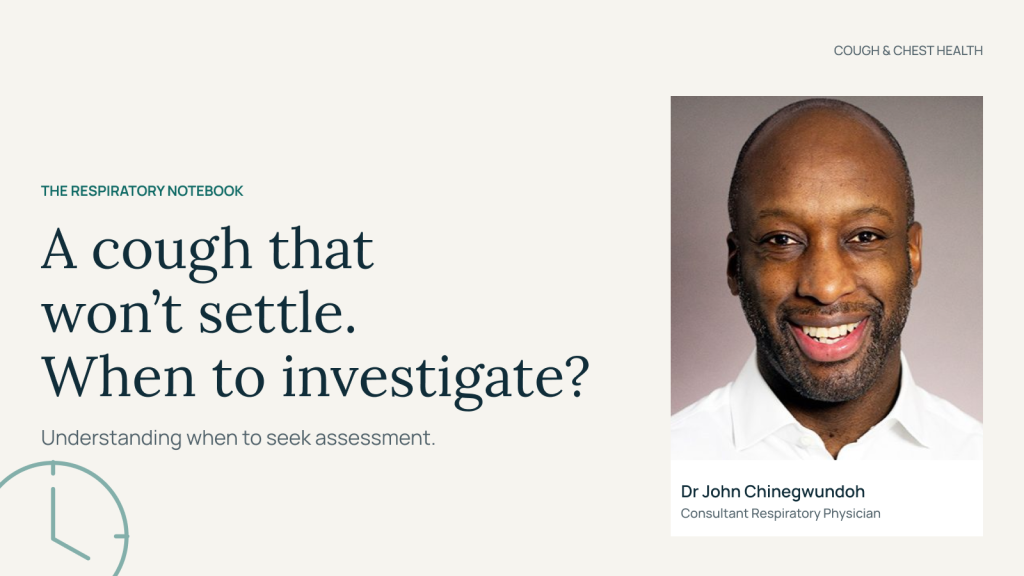
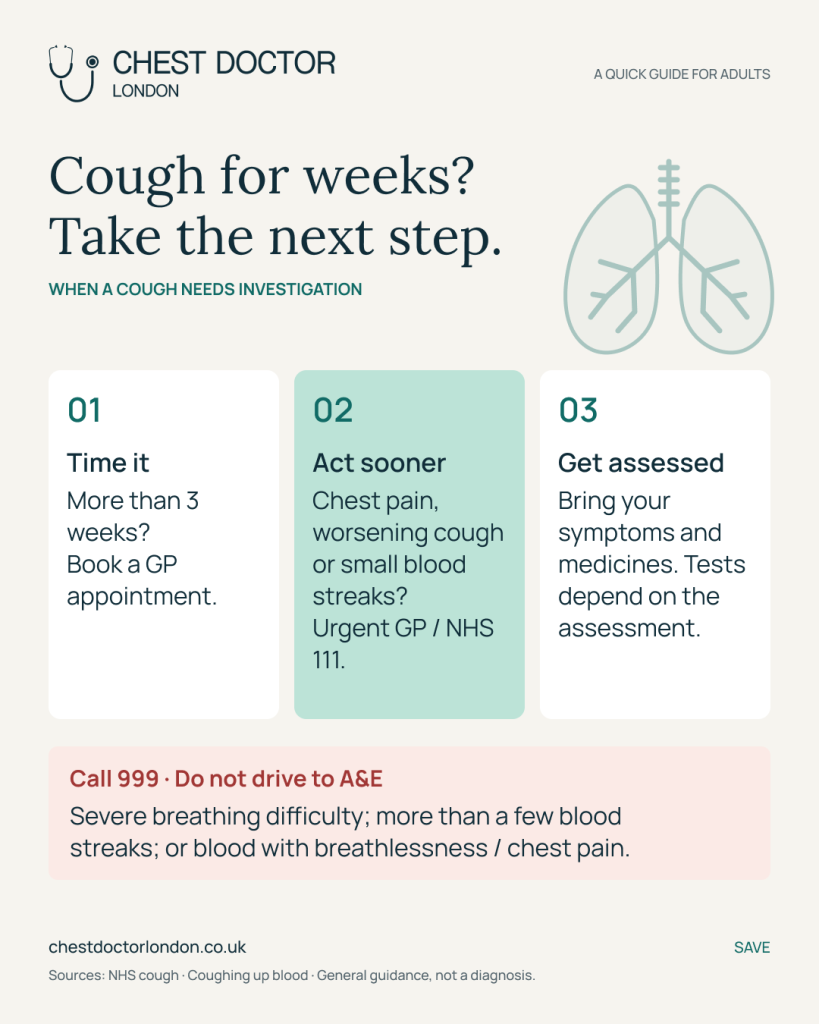
See a GP if your cough lasts more than three weeks. Most coughs clear within three to four weeks, but persistent symptoms deserve assessment. In adults, a cough lasting more than eight weeks is called a chronic cough. You should seek help sooner if you have warning symptoms.
This guide covers adults. Children need a separate assessment approach.
When does a cough need urgent help?
Call 999 if:
- You have severe difficulty breathing, are gasping or cannot get words out.
- Your chest feels tight or heavy, or pain spreads to your arms, back, neck or jaw.
- You cough up more than a few spots or streaks of blood.
- You cough up blood with difficulty breathing, a very fast heartbeat, or chest or upper back pain.
For more detail about coughing up blood or blood in phlegm, see our separate guide to possible causes and assessment
Do not drive yourself to A&E.
Ask for an urgent GP appointment or contact NHS 111 for a few small streaks of blood, chest pain, difficulty breathing, a rapidly worsening cough, or feeling very unwell.
Also arrange medical assessment for unexplained weight loss, repeated chest infections, persistent hoarseness, difficulty swallowing, or ongoing fever or night sweats. Tell the clinician about smoking and any asbestos exposure. These details can change which investigations are needed.
If you have a weakened immune system, seek GP advice about a cough rather than relying on these duration thresholds.
Cough for three weeks, six weeks or longer: what does it mean?
| Duration in adults | Common clinical term | What to do |
|---|---|---|
| Less than 3 weeks | Acute cough | Often follows an infection. If mild and improving, self-care may be reasonable; warning symptoms need earlier help. |
| 3 to 8 weeks | Subacute cough | A lingering cough after an infection is possible. Book a GP assessment once it lasts more than 3 weeks. |
| More than 8 weeks | Chronic cough | Arrange assessment for ongoing causes and appropriate tests. |
These categories describe duration, not severity. A six-week cough after a cold can still be post-infectious, but this diagnosis depends on the history and exclusion of other explanations. A cough lasting beyond eight weeks needs reassessment rather than continued assumptions about the original infection.
What causes a cough that will not go away?
Several conditions can contribute at the same time. The pattern provides clues, but does not establish a diagnosis.
A persistent cough after a cold
After a respiratory infection, inflammation and a sensitive cough reflex can prolong coughing for several weeks. Post-infectious cough generally resolves without specific drug treatment. A cough that worsens, develops warning symptoms or continues beyond eight weeks needs further review.
A persistent dry or tickly cough
Possible explanations include:
- Asthma or eosinophilic bronchitis. Cough can occur without obvious wheezing. Both can involve airway inflammation that responds to an inhaled corticosteroid when appropriately diagnosed.
- Nasal or sinus symptoms. Rhinitis and sinusitis can accompany cough, throat clearing and a sensation of mucus at the back of the throat. That sensation alone does not prove the cause.
- Cough hypersensitivity. An unusually sensitive cough reflex can make talking, cold air or smells trigger coughing. Symptoms may continue despite treatment of associated conditions.
ACE inhibitor medicines, such as ramipril, can also cause a persistent dry cough. Ask the prescriber to review your medicine if this happens. Do not stop or change it yourself.
Reflux may contribute, particularly with heartburn or regurgitation. Cough or hoarseness alone is not enough to assume “silent reflux”. Acid-suppressing medicines should not routinely be prescribed for cough without typical reflux symptoms or other evidence of acid reflux.
A constant cough with mucus
Daily phlegm, breathlessness and recurring chest infections can occur with COPD. A persistent productive cough also raises the possibility of bronchiectasis, a condition involving widened, damaged airways. Assessment may include sputum testing and, if bronchiectasis is suspected, a CT scan. Airway clearance techniques are part of bronchiectasis treatment.
Coughing fits and whooping cough
Whooping cough can cause prolonged coughing bouts, often worse at night and sometimes followed by vomiting. Some adults do not make a whooping sound. The cough can last weeks or months. Antibiotics given early may reduce spread, but may not shorten the cough.
Other possible causes
Smoking, infections and less common conditions such as pulmonary fibrosis, tuberculosis or lung cancer may need consideration. A persistent cough without a preceding cold still needs assessment.
When should you have an urgent chest X-ray?
NICE recommends an urgent chest X-ray for people aged 40 or over who have:
- Two or more unexplained symptoms from cough, fatigue, breathlessness, chest pain, weight loss and appetite loss; or
- One or more of those unexplained symptoms and any previous smoking history.
“Urgent” in this guidance means before two weeks. These criteria do not require waiting until a cough has lasted three weeks. People aged 40 or over with unexplained coughing up of blood should be referred through a suspected cancer pathway.
What tests investigate a persistent cough?
Your clinician will ask about the start of the cough, triggers, medicines, smoking, work exposures and associated symptoms, then examine you. Bring a medication list and any previous test results. More than one appointment or a monitored treatment trial may be needed.
For adult chronic cough, the British Thoracic Society recommends a chest X-ray, full blood count, spirometry and FeNO testing if available.
- Spirometry measures how you breathe out. Testing before and after a bronchodilator can help assess reversible airflow obstruction.
- FeNO and blood eosinophils help assess inflammation relevant to asthma. Normal initial results do not always exclude asthma; further testing may be needed when suspicion remains. Read more about asthma assessment.
- Sputum or allergy tests may help when infection or allergy is suspected.
- Bronchoscopy allows direct examination of the airways and collection of samples when there is a specific reason to investigate further.
CT and bronchoscopy are not routine tests for every persistent cough.
If breathlessness accompanies your cough, our guide to tests for unexplained breathlessness explains how investigations are selected for that symptom.
What if your chest X-ray is normal but you are still coughing?
A normal chest X-ray does not exclude every cause of cough or rule out lung cancer completely. Persistent symptoms need follow-up, particularly if they change or warning symptoms develop.
The next step depends on the assessment and previous treatment. Specialist review may be appropriate if the diagnosis remains unclear. CT is reserved for clinical indications, such as suspected bronchiectasis or cancer.
How is a persistent cough treated?
Treatment depends on the findings. It may involve treating airway inflammation, managing nasal symptoms, changing a cough-causing medicine, or treating infection. Some patients with ongoing cough hypersensitivity benefit from specialist cough control therapy, which teaches techniques to reduce coughing.
While awaiting assessment:
- Rest and drink fluids. A warm honey drink may soothe symptoms, although evidence of benefit is limited.
- Ask a pharmacist whether a cough medicine is suitable. Some products may reduce coughing but will not address every cause.
- Avoid tobacco smoke and discuss smoking cessation support if needed.
- Record when the cough is worst and whether it produces phlegm.
Antibiotics are not routinely needed for an uncomplicated acute cough. They may be appropriate when someone is very unwell or at higher risk of complications, following clinical assessment.
Frequently asked questions
Can a persistent cough be lung cancer if I have never smoked?
Yes, lung cancer can occur in people who have never smoked. Smoking is a major risk factor, but its absence does not exclude the disease. Persistent or changing symptoms still need assessment.
Should I wait for lung cancer screening?
No. Screening is intended to detect disease early, sometimes before symptoms. In England, lung health checks are being rolled out for eligible people aged 55 to 74 who currently smoke or previously smoked. Availability varies by area. A persistent or changing cough needs a GP assessment regardless of screening eligibility.
Why is my cough worse at night?
Asthma, nasal symptoms and reflux may contribute. Night-time coughing is a useful detail to report, but it does not identify the cause by itself. Tell the clinician whether it follows meals, worsens when you lie down or interrupts sleep.
What if I have a persistent cough and fatigue?
Unexplained fatigue accompanying cough should be mentioned at assessment. In someone aged 40 or over, these two unexplained symptoms meet NICE’s urgent chest X-ray criteria, even without a smoking history.
Private respiratory care · London & Surrey
Book an appointment
Dr John Chinegwundoh
Consultant Respiratory Physician
Arrange a private consultation at a location that works for you.
Book an appointmentOr call Dr John’s PA on 020 8949 9012

This information supports, but does not replace, an individual clinical assessment.
Consultant Respiratory Physician practising in London and Surrey, and Senior Physician in Respiratory Medicine at Kingston and Richmond NHS Foundation Trust.
He graduated from Cambridge and completed his doctorate at Columbia University, New York. He is a Fellow of the Royal College of Physicians and President of the Cambridge Medical Graduates’ Society.
MA MB BChir MD (Cantab) FRCP · GMC 4117379 · Book an appointment