
Chest Infection vs Pneumonia: Explained by Dr John
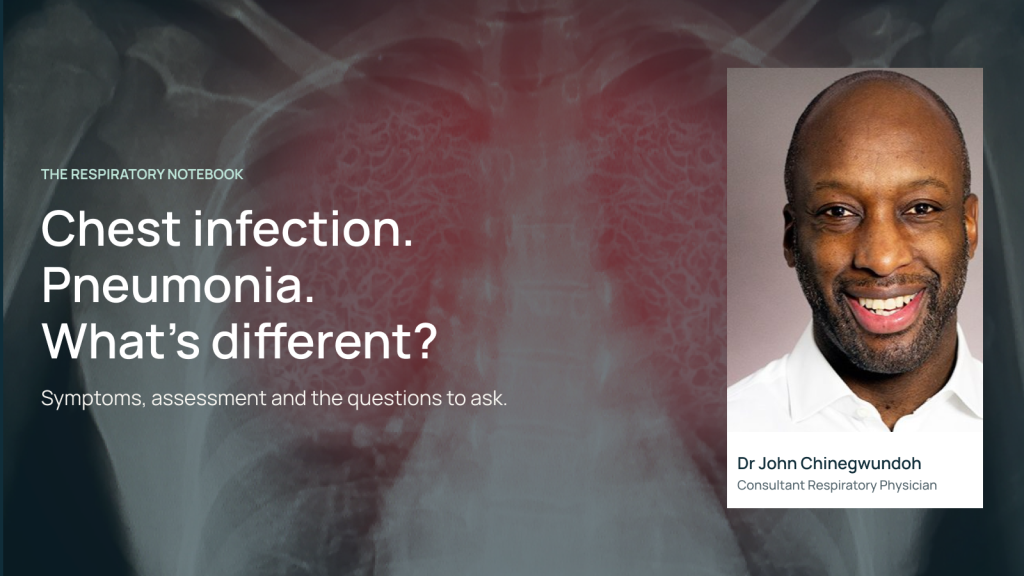
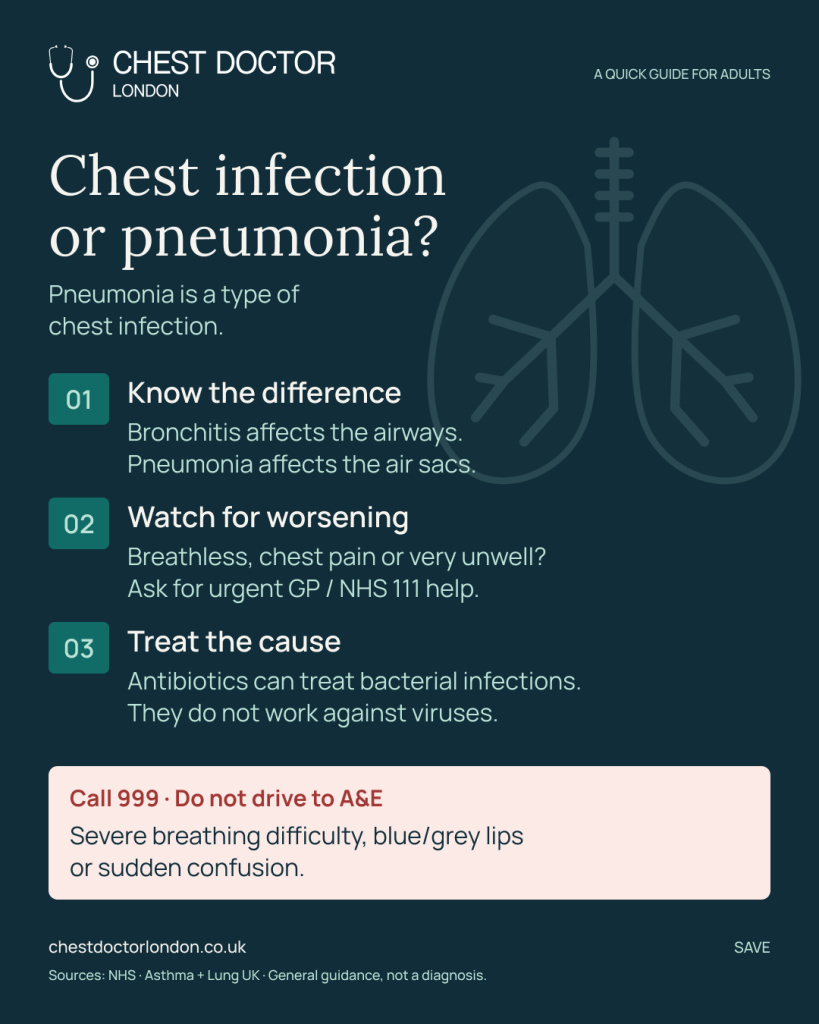
Pneumonia is a type of chest infection, not a separate illness. Chest infection is the general term for an infection in the lungs or airways. Pneumonia is the more serious form, where the infection reaches the tiny air sacs deep in the lung rather than staying in the airways above them. So if your GP has told you that you have a chest infection, that does not rule pneumonia out; it may simply mean the exact depth of the infection has not yet been established.
That distinction causes a lot of unnecessary worry, and occasionally some false reassurance. This page covers how to know if you have a chest infection, what causes them, whether you need antibiotics, how long recovery should take, and when a chest infection deserves a specialist opinion rather than another prescription.
Dr John Chinegwundoh is a Consultant Respiratory Physician working across central London, Kingston and Surrey. Chest infections are among the most common reasons patients are referred to him.
Seek urgent help if any of these apply
Do not wait for a private appointment. Call 999 or go to your nearest emergency department if you or someone with you has:
- Severe difficulty breathing, or breathlessness while sitting still
- Blue or grey lips, face or fingertips
- New confusion, drowsiness or difficulty staying awake
- Coughing up blood
- Chest pain that is severe, or spreads to the arm, neck or jaw
- A very high temperature with uncontrollable shaking (rigors)
- A rash that does not fade when a glass is pressed against it
Contact your GP or an urgent care service the same day if you are getting worse rather than better after three days, or if you are over 65, pregnant, or living with COPD, asthma, bronchiectasis, heart disease, diabetes or a weakened immune system.
What does “chest infection” actually mean?
Air travels from your windpipe into two main airways, then divides again and again into progressively smaller tubes, ending at roughly 300 million microscopic air sacs called alveoli. Gas exchange oxygen in, carbon dioxide out – happens only in those air sacs.
A chest infection is any infection of the lower respiratory tract, meaning anywhere from the windpipe downwards. It is the same thing as a lung infection in everyday use, though we tend to write “lower respiratory tract infection” in the notes. Where in the airway the infection settles determines both what it is called and how ill it makes you.
Acute bronchitis is infection and inflammation of the airways themselves. The tubes swell and produce more mucus, which is why the cough is productive, and the chest often feels rattly or crackly when you breathe in. Gas exchange carries on more or less normally, which is why most people with bronchitis feel unwell but not desperately so. The great majority of cases are viral.
Pneumonia is an infection of the lung tissue at the level of the air sacs. Those sacs fill with fluid and inflammatory cells, so a section of lung stops doing its job. That is why pneumonia produces breathlessness, a higher temperature and a much heavier sense of illness. Bacteria are more often responsible, though viruses and, less commonly, fungi can also cause it.
Both are chest infections. One is considerably more serious than the other.
Signs and symptoms of a chest infection in adults
What a straightforward chest infection looks like
- A persistent chest cough, usually bringing up yellow or green mucus
- Wheezing, or a rattling sensation when breathing in
- A mild temperature, or sometimes none at all
- Chest soreness or a burning feeling behind the breastbone, generally from the effort of coughing
- Tiredness, aching muscles and headache
- A blocked or runny nose in the days beforehand
You feel unwell, but you can usually still function.
Signs pointing towards pneumonia
- Breathlessness, including at rest or on minimal exertion
- A high temperature, sometimes with rigours (uncontrollable shaking)
- Sharp chest or rib pain that is noticeably worse on breathing in (pleuritic pain)
- A rapid heartbeat, or fast, shallow breathing
- Profound fatigue and complete loss of appetite
- Confusion, particularly in older adults, where it is sometimes the only obvious sign
- Cough, which may be dry rather than productive, and may be less prominent than you would expect
The most useful single guide is not how much you are coughing. It is how ill you feel. A ferocious cough with a clear head and a normal appetite points towards bronchitis. A moderate cough alongside a high temperature, breathlessness and complete exhaustion points towards pneumonia, and needs assessing properly.
Can you have a chest infection without a temperature, or without a cough?
Yes, to both, which is why neither absence is reassuring on its own.
Plenty of chest infections run without fever, particularly in older adults, in people taking steroids or other immunosuppressive medication, and in those who have been taking paracetamol or ibuprofen regularly. Temperature is a useful signal when it is present and a poor one when it is absent.
A chest infection without a cough is less common but does happen. In frail or elderly patients, pneumonia sometimes presents as confusion, a fall, or simply not being themselves, with no respiratory complaint at all. In those cases, the diagnosis is easy to miss and worth actively considering.
Chest infection with a rash
Most chest infections do not cause a rash, so one is worth paying attention to rather than dismissing.
The rash that needs immediate action is one that does not fade when you press a glass against it. Combined with fever, this can indicate blood poisoning or meningococcal infection, and it is a 999 call rather than a wait-and-see.
Otherwise, three explanations are common. Some viruses that cause chest infections also produce a widespread pink blotchy rash. Mycoplasma pneumoniae, the organism behind so-called walking pneumonia, is particularly associated with skin reactions, including target-shaped patches on the arms and legs. And a rash appearing after antibiotics have been started may be a drug reaction; report that promptly, as it affects what you can safely be given in future.
Any rash accompanied by facial or tongue swelling, or by difficulty breathing, needs emergency assessment.
Chest infection and diarrhoea
Also possible, and it usually has one of two explanations. Certain organisms, Legionella and Mycoplasma among them, produce stomach upset alongside chest symptoms. More often, though, diarrhoea is a side effect of the antibiotics rather than the infection itself.
If diarrhoea is severe, persists after the course finishes, or contains blood or mucus, contact your doctor. Antibiotics can occasionally disturb gut bacteria enough to allow Clostridium difficile to take hold, which needs specific treatment.
Fatigue
Tiredness during and after a chest infection is expected, often out of proportion to the cough. Your immune system is using a great deal of energy, and inflammation itself is exhausting. After pneumonia in particular, fatigue is usually the last symptom to lift.
Persistent tiredness only becomes a concern when it continues well beyond the timelines below, or when it comes with breathlessness that has not improved. Both are worth investigating properly rather than waiting out.
Chest infection vs pneumonia: the differences at a glance
| Acute bronchitis (common chest infection) | Pneumonia | |
|---|---|---|
| What is infected | The airways carrying air to the lungs | The air sacs and surrounding lung tissue |
| How ill you feel | Under the weather; usually able to function | Genuinely unwell; often unable to get out of bed |
| Temperature | Mild or absent | Often high, sometimes with shaking chills |
| Cough | Prominent, productive, the main complaint | Present, sometimes dry, not always the worst symptom |
| Breathlessness | Uncommon at rest | Common, and a key warning sign |
| Chest pain | Vague soreness from coughing | Often sharp and worse on breathing in |
| Usual cause | Viral | More often bacterial |
| Antibiotics | Rarely helpful | Usually necessary |
| Chest X-ray | Normal | Shows shadowing in the affected area |
Is it flu, a cold, or a chest infection?
These overlap, and the sequence usually tells you more than any single symptom.
A cold starts in the nose and throat: sneezing, congestion, sore throat, and a cough that is a secondary nuisance. It builds over a day or two.
Flu arrives suddenly and hits the whole body. Fever, aching muscles, headache and exhaustion within hours, often before much cough at all. People remember the actual hour the flu started; they rarely remember when a cold began.
A chest infection is centred on the chest itself: a deep, productive cough, a rattling or crackling sensation on breathing, and soreness behind the breastbone.
Can a cold turn into a chest infection? Yes, and the pattern to watch for is a cold that was improving, then abruptly worsened around day five to seven with a rising temperature and a deeper cough. That suggests a bacterial infection has followed the viral one.
Is a chest infection contagious?
What passes between people is the virus or bacterium, not the chest infection itself. It spreads through droplets from coughs and sneezes, and from hands touching contaminated surfaces. Whether the person who catches it develops a simple cold or a full chest infection depends largely on their own airways and immune system. So you can catch the organism from someone with a chest infection and end up with nothing worse than a sore throat.
Viral chest infections are generally most contagious in the first few days, roughly while fever is present. Bacterial pneumonia becomes considerably less infectious after around 48 hours of effective antibiotics. As a rough guide, stay away from work while you have a fever and feel unwell, and take particular care around anyone elderly, pregnant, or receiving treatment that weakens the immune system.
What causes chest infections?
Viruses. Most chest infections seen across London and Surrey each winter are viral: rhinovirus, influenza, respiratory syncytial virus (RSV), parainfluenza and SARS-CoV-2. Viral infection usually settles by itself, though it can leave the airway inflamed and vulnerable for several weeks afterwards.
Bacteria. Bacterial infection is more often behind pneumonia. Streptococcus pneumoniae is the most frequent cause. Haemophilus influenzae is common in people with existing airway disease, and Mycoplasma pneumoniae produces the milder, slower illness sometimes called walking pneumonia, easy to dismiss precisely because it does not floor you.
Fungi. Uncommon, but relevant in people with damaged airways, bronchiectasis or a weakened immune system.
Aspiration. When food, drink or stomach contents end up spilling into the airways, infection can follow. More likely after a stroke, with swallowing difficulties, with significant acid reflux, or after heavy alcohol use.
What raises your risk
- Age. Very young children and adults over 65 are more vulnerable.
- Existing lung disease. COPD, asthma, bronchiectasis and pulmonary fibrosis all increase susceptibility, and infection tends to be more severe.
- Smoking and vaping. Smoking damages the tiny hairs that clear mucus from the airways, leaving infection able to settle.
- A weakened immune system, through illness, chemotherapy, steroids or other immunosuppressive treatment.
- Other long-term conditions, including diabetes, heart failure, and chronic kidney or liver disease.
- Air pollution. Long-term exposure to particulate matter and nitrogen dioxide is associated with greater respiratory vulnerability, which is relevant to a great many of my patients in London.
The stages of a chest infection
Infections do not follow a rigid script, but the usual arc runs like this.
Days 1–3: onset. Often preceded by cold symptoms. The cough moves from the throat down into the chest and starts producing mucus. A mild temperature is common.
Days 3–7: the peak. Mucus production is heaviest, and the cough is at its most disruptive, frequently worse at night. This is the window in which most people decide whether to seek help. It is also the point at which a straightforward infection and a developing pneumonia begin to diverge – one starts easing while the other keeps intensifying, adding breathlessness and higher fever.
Weeks 2–3: the tail. Temperature settles and mucus thins, but the cough persists. The airway lining is still inflamed and recovering; the infection has largely gone.
Week 3 onwards: resolution. Coughing gradually fades. Fatigue may linger longer than the cough.
A chest infection lasting 3 weeks is normal. One that is worsening at three weeks, or that improved and then relapsed, is not, and should be reviewed.
What can a chest infection turn into? Most turn into nothing at all and simply clear. The ones that do progress become pneumonia, or occasionally lead to fluid collecting around the lung (pleural effusion or empyema). Bacteria getting into the blood stream can lead to a serious illness termed septicaemia. In people with asthma or COPD, an infection can also trigger a flare-up of the underlying condition, which then needs treating in its own right.
How is a chest infection diagnosed?
Assessment begins with your history and an examination: listening to the chest, checking temperature, pulse, breathing rate and oxygen saturation with a finger probe.
Where the picture is unclear or you are significantly unwell, further tests may include:
- Chest X-ray, the single test that distinguishes bronchitis from pneumonia, since pneumonia produces visible shadowing where bronchitis does not
- Blood tests, to gauge the degree of inflammation and check kidney function before treatment
- Sputum culture, to identify the organism and its antibiotic sensitivities, particularly valuable in recurrent or treatment-resistant infection
- CT scan, when finer structural detail is needed, or an X-ray has not cleared as expected
- Lung function testing, where underlying asthma or COPD may be contributing
You may not need all of these. Every investigation should answer a specific question rather than be ordered as a matter of routine.
Treating a chest infection
Will a chest infection go away on its own?
Most do. Viral infections cannot be shortened by antibiotics, and in an otherwise healthy adult the body clears them without help. What genuinely aids recovery:
- Rest and fluids. Staying well hydrated keeps mucus loose and easier to clear.
- Paracetamol or ibuprofen for fever and aches, taken as directed.
- Honey in warm water – as effective as most over-the-counter cough preparations, and cheaper. Never give honey to a child under one year old.
- Stopping smoking, even temporarily, measurably speeds recovery.
- Sitting upright rather than lying flat, which makes coughing more productive.
On steam inhalation: it is a long-standing home remedy, but it has not been shown to shorten infections and causes a significant number of scald injuries every year, particularly in children. Sitting in a steamy bathroom is a safer way to get the same soothing effect than leaning over a bowl of boiling water. Cough suppressants are of limited value and can be counterproductive when you need to clear mucus.
Do you need antibiotics for a chest infection?
Often not. Antibiotics treat bacteria and have no effect on viruses, which cause most chest infections. Prescribing them unnecessarily brings side effects, including diarrhoea and rashes, and contributes to antibiotic resistance.
Antibiotics are appropriate when pneumonia is suspected, when you are significantly unwell, or when you fall into a higher-risk group. Sometimes a delayed prescription is the sensible middle course: you hold it and start only if things have not improved after a few days, or if you get worse.
Which antibiotic is suitable depends on the likely organism, your allergies, your kidney function and local resistance patterns. That is a decision for a clinician who has examined you, which is why I have not listed specific drugs here. If you have COPD and hold a rescue pack of antibiotics and steroids, use it according to your agreed plan and tell your clinician you have done so.
What if the antibiotics are not working?
If you are no better after 48 to 72 hours, act on it rather than waiting it out. There are several possible explanations: the infection may be viral, in which case the antibiotic was never going to work; the organism may be resistant to the one chosen; the infection may have progressed to pneumonia or a complication such as fluid around the lung; or the diagnosis may not have been infection at all.
This is exactly the situation in which a sputum sample and a chest X-ray earn their place. It is also one of the commonest reasons patients are referred to me.
Treating pneumonia
Most people with pneumonia are treated at home with oral antibiotics, rest and fluids, with review to confirm improvement. Hospital admission becomes necessary when oxygen levels are low, when breathing or heart rate is significantly raised, when confusion is present, or when other conditions make the illness riskier. Hospital treatment may involve intravenous antibiotics, oxygen and closer monitoring.
Complications are uncommon but real, and include fluid collecting around the lung (pleural effusion or empyema) and, rarely, spread of infection into the bloodstream. In a vulnerable person, untreated pneumonia remains a serious illness.
Prevention
- Vaccination. The annual flu jab and the pneumococcal vaccine both reduce risk and are offered on the NHS to over-65s and to people with certain long-term conditions. COVID-19 and RSV vaccination are offered to eligible groups.
- Stopping smoking, the single most effective step available.
- Hand hygiene, particularly through winter.
- Treating the underlying condition. Well-controlled asthma or COPD means fewer and milder infections.
How long does recovery take?
After bronchitis, the cough commonly lasts around three weeks and sometimes longer, with or without antibiotics. That is normal and does not by itself mean the infection has become pneumonia. What matters is the direction of travel.
f your cough lasts more than three weeks, arrange a GP assessment. Our guide explains when a persistent cough needs investigation and what tests may be considered.
After pneumonia, recovery is slower and fairly predictable. Fever usually settles within the first week of effective treatment. Chest pain and mucus production ease over two to four weeks. The cough typically continues for around a month. Fatigue is the last thing to resolve, and it is common to still feel below par at six weeks and not fully back to normal for three months. Being tired months later is not a sign that treatment failed; it is the usual course of the illness.
Flying is best avoided while you have a fever or are breathless. Cabin pressure is equivalent to an altitude of around 6,000 to 8,000 feet, which reduces the oxygen available to you. After pneumonia, seek individual advice before long-haul travel.
Why your GP may have said “chest infection” when it was pneumonia
A stethoscope is a good instrument but not a precise one. Listening to the chest tells a doctor that something abnormal is happening in the lower airways. It does not reliably reveal how deep the infection has gone. Early pneumonia, pneumonia sitting behind the heart, and pneumonia in a small segment of lung can all sound very much like bronchitis. The only way to establish where the infection actually is, is to image the chest.
“Chest infection” is therefore an honest description of what a clinician can be certain of at the bedside, and it is a genuinely useful term. But it carries an implication of mildness that is not always warranted. If you were told you had a chest infection and you are more unwell than that label suggests, ask to be reassessed.
When a chest infection is a sign of something else
Most chest infections are exactly what they appear to be. The ones that concern me are those behaving unusually, because they are sometimes the first visible sign of a problem that was already there.
Infections that keep returning in the same part of the lung. Recurrence in one specific area is a different thing from catching several unrelated infections in one bad winter. It can indicate a structural problem in the airways, an area of bronchiectasis, a narrowing, or something obstructing drainage, allowing infection to establish itself in the same place repeatedly.
Infections that do not clear. When symptoms and imaging fail to resolve after appropriate treatment, the question changes. Sometimes the organism was not what was assumed. Occasionally the appearance on the X-ray was never infection in the first place.
Repeated infections in someone who has never had them before. A pattern beginning in adulthood may point to undiagnosed asthma, COPD, reflux spilling into the airway, or a problem with immune function.
Pneumonia that has not been followed up on imaging. After pneumonia, a repeat chest X-ray several weeks later confirms the lung has cleared. This matters particularly in people over 50 and in anyone who has ever smoked, because persistent shadowing occasionally reflects something other than infection. It is easily missed when care has been split between an out-of-hours service, a walk-in centre and a GP practice, and it is one of the more common gaps I see in patients arriving after a difficult winter.
In all of these situations, the principle is the same one I apply to every respiratory problem: establish a clear diagnosis first, on objective evidence, and then treat what you have actually found.
If infections keep returning, our guide to why you keep getting chest infections explores the underlying causes and how the pattern is investigated.
Specialist assessment with Dr John Chinegwundoh
Dr John Chinegwundoh has been a Consultant Respiratory Physician since 2004. He spent four years as Clinical Director for Medicine at Kingston Hospital, currently serves as President of the Cambridge Medical Graduates’ Society, and leads a predictive AI project with Johnson & Johnson and South West London ICB focused on earlier detection of lung cancer.
A respiratory opinion is worth seeking when:
- Symptoms are not improving after a reasonable course of treatment
- You have had two or more chest infections in a single season
- An X-ray or scan showed a change that has not been followed up
- You are coughing up blood, or bringing up mucus most days
- Breathlessness or fatigue has persisted well beyond the infection itself
- You want to understand why this keeps happening, not simply treat the current episode
Private respiratory care · London & Surrey
Book an appointment
Dr John Chinegwundoh
Consultant Respiratory Physician
Arrange a private consultation at a location that works for you.
Book an appointmentOr call Dr John’s PA on 020 8949 9012

Frequently asked questions
Is pneumonia the same as a chest infection?
Pneumonia is one type of chest infection, the more serious kind, affecting the air sacs rather than only the airways. "Chest infection" is the umbrella term. All pneumonia is a chest infection; most chest infections are not pneumonia.
Is a chest infection bacterial or viral?
Most are viral, particularly acute bronchitis. Pneumonia is more often bacterial. The two cannot be told apart by the colour of your phlegm, and often not by examination alone, which is why a chest X-ray is sometimes needed.
Can you catch a chest infection from someone?
You can catch the virus or bacteria that caused it, though you may develop only a mild cold rather than a chest infection yourself. Viral infections are most contagious in the first few days; bacterial pneumonia is much less so after around 48 hours of antibiotics.
Can you have a chest infection without a temperature?
Yes. Fever is often absent, particularly in older adults and in anyone taking steroids or regular paracetamol. Its absence does not rule out infection.
How long does a chest infection last without antibiotics?
Most viral infections settle within one to three weeks, and the cough alone can persist for three weeks or more. A cough that is slowly improving is behaving normally.
My antibiotics are not working – what should I do?
Contact your doctor if you are no better after 48 to 72 hours. The infection may be viral, the organism resistant, or the diagnosis something other than a simple chest infection. A chest X-ray and a sputum sample usually clarify matters.
Can a chest infection make you tired?
Yes, and often disproportionately. Fatigue is normal during recovery and is typically the last symptom to lift after pneumonia. Tiredness that persists well beyond the expected timeline, especially with breathlessness, is worth investigating.
Can I get a private chest X-ray in Kingston?
Yes. On-site imaging is available at The New Victoria Hospital in Kingston upon Thames, and at my clinics in Chelsea and Ashtead, so imaging can usually be arranged around your consultation rather than requiring a separate appointment.
Do I need a GP referral to see you privately?
Not necessarily; many patients self-refer. If you hold private medical insurance, your insurer will usually require a GP referral letter and issue an authorisation number.
Should I have a follow-up X-ray after pneumonia?
Frequently, yes. A repeat film several weeks after recovery confirms the lung has cleared, and this matters particularly if you are over 50 or have ever smoked. If nobody has arranged one, it is reasonable to ask.
This page provides general information and is not a substitute for individual medical assessment. If your symptoms are severe or worsening rapidly, seek urgent medical help rather than waiting for a private appointment.
References
- NHS. Chest infection. https://www.nhs.uk/conditions/chest-infection/
- Asthma + Lung UK. What is pneumonia? https://www.asthmaandlung.org.uk/conditions/pneumonia/what-is-it
- National Institute for Health and Care Excellence. Chest infections – adult. NICE Clinical Knowledge Summaries.
- National Institute for Health and Care Excellence. Pneumonia: diagnosis and management.
- British Thoracic Society. Guidelines for the management of community acquired pneumonia in adults.
Consultant Respiratory Physician practising in London and Surrey, and Senior Physician in Respiratory Medicine at Kingston and Richmond NHS Foundation Trust.
He graduated from Cambridge and completed his doctorate at Columbia University, New York. He is a Fellow of the Royal College of Physicians and President of the Cambridge Medical Graduates’ Society.
MA MB BChir MD (Cantab) FRCP · GMC 4117379 · Book an appointment